- Home
Happy Hardcore
- 2000s HHC T-RackS preset
- Happy hardcore resources
- Synths and samples
- Rave piano tricks & tips
- How to supersaw
My stuff
- VST plugins
- My music
Opinions & Other
- Quick & easy cover art

So you want to make happy hardcore?
What is Happy Hardcore? (2000s style)
Happy Hardcore is generally between 170-175 bpm (you can go a bit below or above too). "four on the floor" beat, typically with a simple off-beat bass. Often there's a supersaw lead, and vocals are common. Themes and melodies are uplifting and euphoric, which contrasts the fast tempo and "darker" sounding rave elements.
This is a guide for getting started making happy hardcore in the 2000s style. It isn't a complete comprehensive guide to music production but should hopefully be enough to get you well on your way. Remember that making music is art, and in art you learn rules so that you know when and why to break them.
If you've never made music on a computer before, there are a few things you will need to start.
Starting From Zero
The DAW
First you need a Digital Audio Workstation. At time of writing there are three "big" ones. There are endless arguments online over which one is the best. All three have free trials and extensive tutorials. Try all of them! Find which one you have the most fun with and then stick to it.
You can do everything you need in all three of these. There are different sets of tools in each, and the workflow is different, but you will not miss out on any meaningful capabilities with any of these choices. Making music is supposed to be something you enjoy doing, so whichever workflow feels the best to you is the only point that matters.
When you've settled on your favorite, play around with it for a bit! Don't worry about finishing a song or making something professional sounding yet, play around and enjoy making noises. The whole time you do that you're building familiarity with it, which is an unavoidable requirement to making music.
A Synthesizer
This can be one that comes with your DAW or a plugin you get separately. Third-party synths are popular and capable but can be expensive. Either way, pick a synth with a workflow you enjoy to be your main synth and practice it! Being really good with one synth is worth more than being medium-okay at ten.
If you're comfortable with your DAW and one synth, have a small collection of samples, and know the absolute basics of music theory then you're ready for the rest of this guide!
RULE 0: LISTEN TO A LOT OF HARDCORE
Every good musician is a great listener first. Listen to lots and lots of hardcore, figure out which songs are you favorites, what you like about them. You cannot make good music without listening to a lot of it.
Making Happy Hardcore
Beats
Happy Hardcore almost always uses a four on the floor beat. This is a kick drum on every beat, a snare or clap every other beat, and an open hat in between. On top of that more percussion and cymbals are layered to taste.
Beat Basics
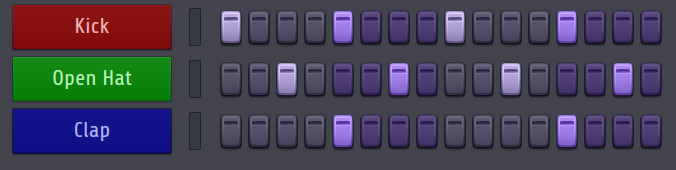
This is the basic form of a hardcore beat, and here's what it sounds like at 175 bpm.
The kick drum is the most important single instrument in a hardcore song and is going to be the backbone of your track, so make sure to put extra effort into picking a good sample. You want something punchy, loud, and hard. Optionally you can use distortion on your kicks, to give them a bouncier sound.
Beat Extras
On top of the basic beat you can (and should) add more percussive elements to increase the energy of your beat.
Ride Cymbals

Putting a ride cymbal on every beat on top of your kick makes it hit a little harder. It is extraordinarily common to do this for parts of the song that you want to hit harder, taking it away during less impactful sections.
Here's what it sounds like on top of the basic beat.
Closed Hats and Percussion
Layering multiple shorter closed hat, shaker, or percussion samples will make your beat sound faster and more energetic. This picture is a layer of three different closed hat samples with different patterns.
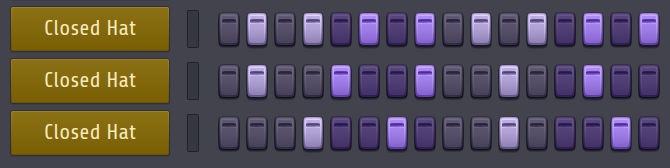
And here's what that sounds like on top of everything else.
Take time to make a unique blend of hats and percussion for each song, it will pay off! Change the panning to be all over the place for bonus points.
Bass
Happy Hardcore is not bass music, nor is there a "standard" bass sound that most songs use. Bass sounds tend towards simple synthesized off-beat bass or even using samples.
Bass Sounds
With the synthesizer you're most comfortable with you have near-complete freedom to design whatever bass sound you like. For tutorial purposes, I'm going to use a simple two-oscillator bass.
The first oscillator is a saw wave, the second oscillator is a square wave tuned one octave lower than the saw wave. Then I've changed the phase of the square wave until it sounds "right". These are the settings I used in FL Studio's 3xOsc synth.
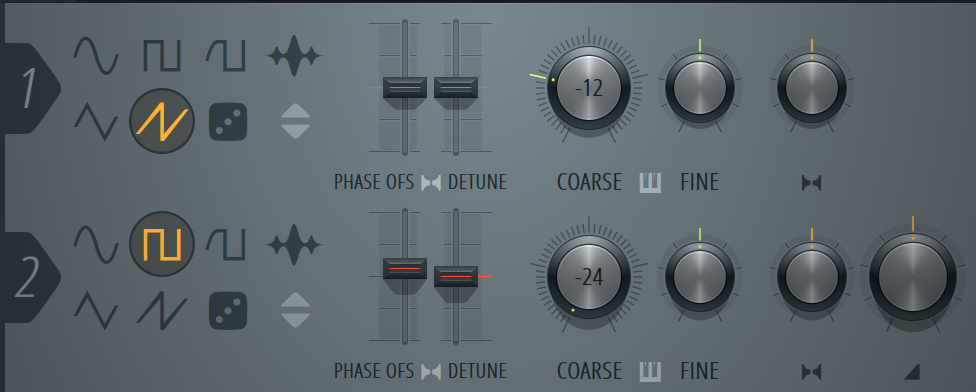
and it sounds like this.
Another common sound would be to take what we made before and put a lowpass filter with a quick decay on it. Something like this.
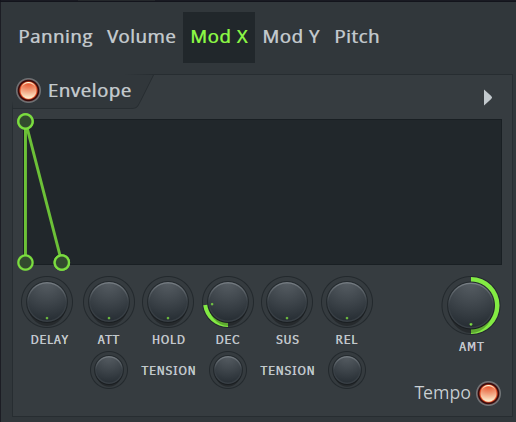
that sounds like this.
Bass Patterns
The basic off-beat bass pattern simply has a bass note on every off-beat and looks like this.
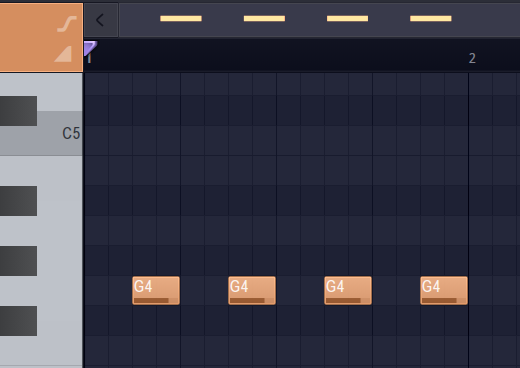
I am playing the note G here, generally the bass follows the root note of whatever chord is currently playing. With a simple synthesized bass sound it sounds like this.
A variation of this pattern is a "rolling" bass, where you have two fast notes instead of the single off-beat bass note, an example of which sounds like this.
TODO
this guide is in progress!